Embedded Basics
The board (or DevKit), as shown earlier, is:
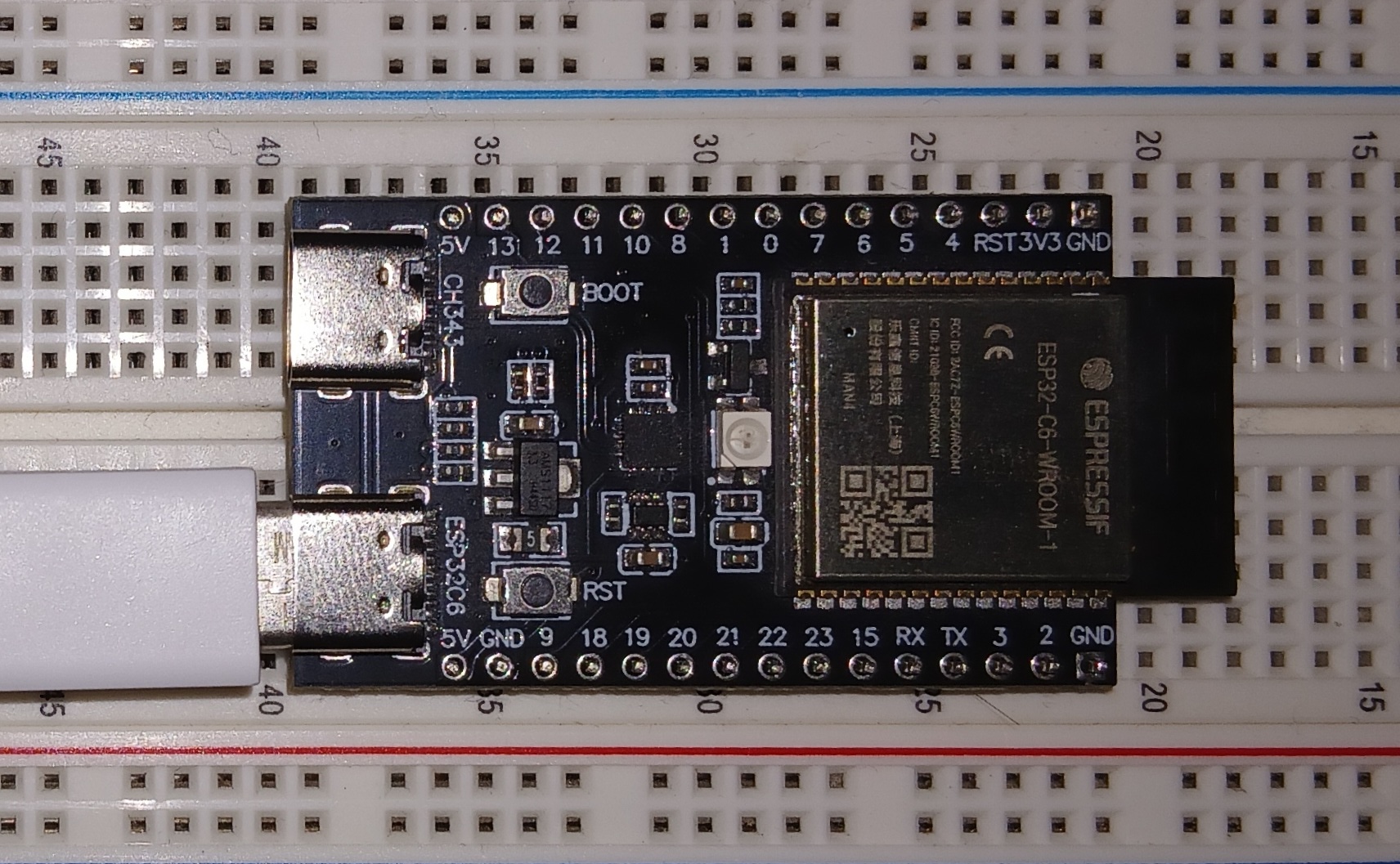
The board then, is the whole item. Its main parts are:
- The printed circuit board (PCB): the flat fiberglass sheet supporting all electronic components.
- The components: items laid on top of the PCB. They interconnect through traces which are thin copper wires. Examples of components: module, USB ports, LEDs, GPIO-pin headers.
So we have the flat piece with the components laid on top. Before zooming further, this is the hierarchy we will be exploring in the definitions (the outer levels contain the inner levels)
- Board
- Module
- SoC (or MCU)
- CPU, ROM, SRAM,
- Advanced Peripherals: Wi-Fi, RF (Bluetooth).
- Peripherals: GPIO, UART, I2C, ADC
- Other Items
- SoC (or MCU)
- Components: USB, LED, GPIO pin-headers
- Module
The description below aren't technical, they are just an overview.
Module
The module is the big square labelled ESP32-C6-WROOM (or some variant). It takes almost half the board.
Within it, a module has a few more items, the key one being the SoC, short for System on a Chip. We can't see the SoC unless we take the module's lid off, but here is how it looks within:
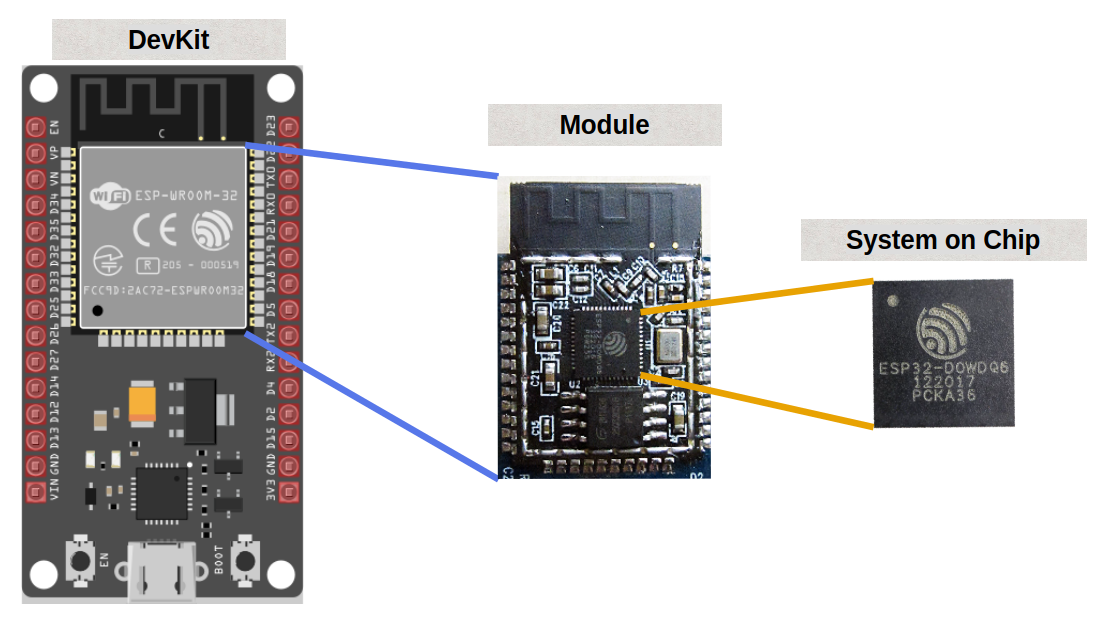
Image from implFerris/esp32-book under CC-BY-SA 4.0
SoC
The SoC includes CPU, ROM, SRAM, advanced peripherals and peripherals. It's an all-in-one integrated circuit or chip.
The advanced peripherals are those making SoC an advanced MCU, like Bluetooth and Wi-Fi.
The peripherals are parts of the SoC placed on the periphery of the CPU, extending its capabilities. For example: GPIO, UART, I2C, SPI, DAC, ADC. We can't see them directly.
The GPIO peripheral is "broken out" into the pin headers at each side of the board. See the [user-guide] schematics and tables for the board.
SoC or MCU?
In this tutorial we consider System on a Chip (SoC) and Micro controller unit (MCU) synonyms. Wikipedia defines MCU and disambiguates SoC or MCU very well (I modified it slightly):
A microcontroller (MC, uC, or μC) or microcontroller unit (MCU) is a small computer on a single integrated circuit. A microcontroller contains one or more processor cores along with memory and programmable input/output peripherals.
In modern terminology, a microcontroller is similar to, but less sophisticated than, a system on a chip (SoC). A SoC may include a microcontroller as one of its components but usually integrates it with advanced peripherals like a graphics processing unit (GPU), a Wi-Fi module, or one or more coprocessors.
In very simple terms, a module contains the SoC which is just an advanced MCU.
Putting it all together
An explanation of how it all comes together is in the micro:bit v2 book, a modified version is provided below:
Our MCU (or SoC) has tiny metal pins sitting right underneath it. These pins and the board components are wired via copper traces, the little "roads" on the board.
The MCU can be programmed to change the electrical state of the pins. The pins change the electrical state of the traces, ultimately controlling the components. So the MCU can control the components.
For example, by enabling or disabling electrical current to flow through a specific pin, an LED attached to that pin (via the traces) can be turned on and off.
Suggested reading
- esp32-c6 user-guide. It describes the board components, peripherals, and pinouts.
- The SoC datasheet, especially the product page, and the features (first 3 or 4 pages).
- implrust's page on the distinction between DevKit (or Board), Module and SoC.